v0.2 archive. This Codex records an early project stage. For current v3 physics start with the home page: common VSB reaches every ACTIVE tile, while neighbour edges carry computation permission only.
Decima-8: Neuromorphic Architecture Operating on Energy Levels
Open specification, Level16, relay activation without routers. v0.2
1. INTRODUCTION
Modern neuromorphic systems face two independent problems.
Problem 1: Information Encoding
Binary spiking neural networks (SNN) transmit signal gradations through:
- Frequency coding (multiple clocks per value)
- Increasing number of transmission lines
Problem 2: Hardware Implementation
Analog memristor crossbars promise natural neuromorphicity, but contain following problems:
- Noise and parameter drift
- Non-deterministic computation
- Each chip requires individual calibration
Traditional Network-on-Chip (NoC) adds overhead:
- ~40% of die area goes to routers
- ~70% of energy spent on data transfer, not computation
Decima-8 offers:
- Level16: encoding activation level (0..15) in one clock on one line. This is a compromise between binary representation and analog continuity.
- Digital crossbars (memristor matrix emulation): determinism, reproducibility, no noise
- Relay activation instead of packet routing: tiles don't transfer data to each other, activation propagates through dependency graph
- Result: fixed latency, predictable behavior, 0% area on routers.
⚛︎ Instead of emulating bio-neurons, we build a tissue where recognition is physics.
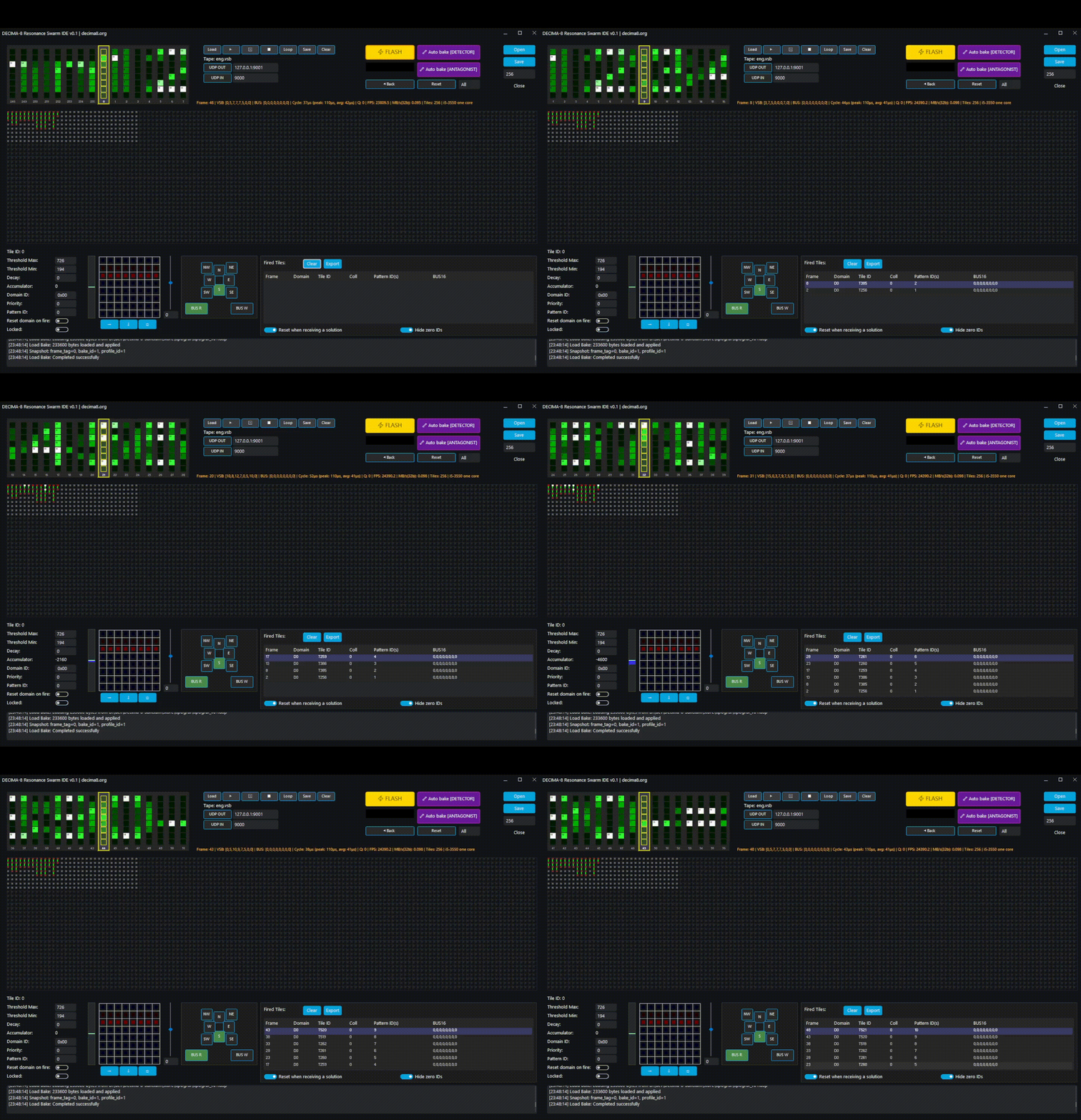
Decima-8 IDE with OCR personality
2. MATHEMATICAL FOUNDATIONS
Decima-8 architecture is based on deterministic integer arithmetic. This section provides computation specifications: data formats, activation formulas, and tile logic. All values have fixed ranges, guaranteeing reproducible results on any hardware.
2.1 Level16: Semantic Tetrad

Level16 in IDE Accordion
In traditional spiking architectures, signal intensity is encoded either in time (spike frequency) or in space (number of parallel channels). Both approaches require compromise: either latency or wiring complexity.
Decima-8 uses Level16 — representing activation level as 4-bit value (0..15) on one line in one clock:
thr_cur16 ∈ [0..15] // 4 bits, one tetrad
This is not an attempt to "emulate analog with digital", but a conscious data format choice:
- Enough gradations for neuromorphic pattern expressiveness
- Fits in nibble — convenient for packed formats and bit operations
- Fixed size — deterministic arithmetic, no dynamic normalization
Physical meaning of Level16:
0— no activation15— saturation1..14— "intention strength" gradations
On VSB bus this is just a signal level. Inside the tile — an operand for arithmetic with SignedWeight5 weights.
💭 Essence: Level16 is not "imprecise int". It's a semantic unit of the architecture, like float32 in classical neural networks. Only deterministic and hardware-friendly.
2.2 SignedWeight5: Weighted Connections with Inhibition
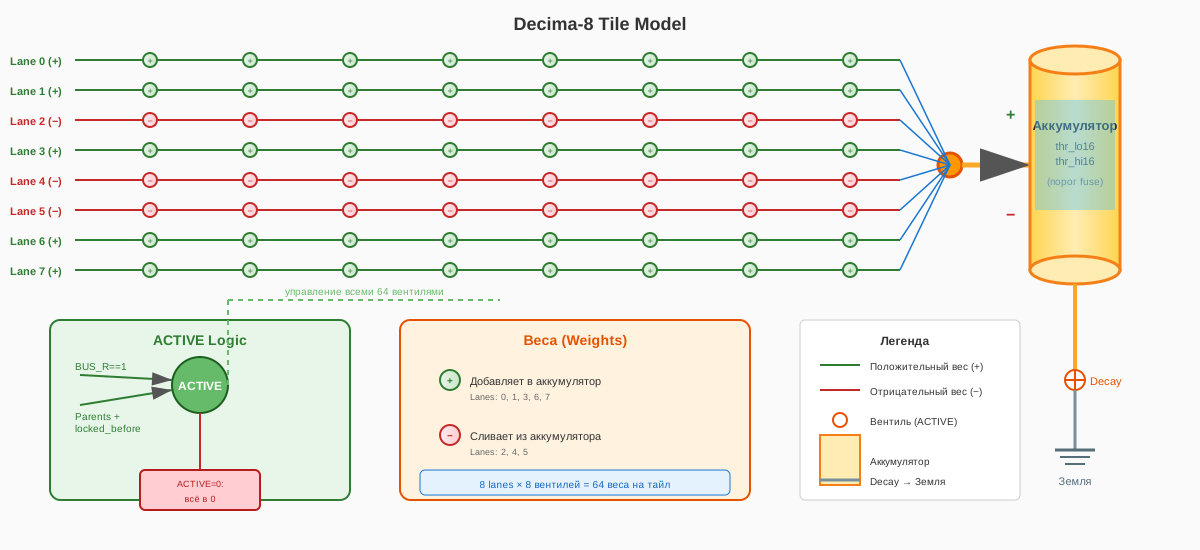
Tile structure: 8 strings → crossbar → accumulator
Each tile contains digital emulation of memristor crossbar sized 8×8. 8 values in16[0..7] (Level16) come as input. Each value is multiplied by its weight and summed per row.
Weight encoding: SignedWeight5 (5 bits)
bits 0-2: magnitude (0..7)   // modulus
bit 3:    sign (0=-, 1=+)    // sign
bit 4:    reserved (0)       // alignment
Weight range: [-7..+7]. Negative weights implement lateral inhibition at hardware level — this is not emulation, but direct consequence of signed arithmetic.
Formula for one crossbar row:
row_raw_signed[r] = Σ (in16[i] × weight[r][i]) // i=0..7
Since in16[i] ∈ [0..15] and weight ∈ [-7..+7], one cell's contribution lies in range [-105..+105]. Sum over 8 inputs gives [-840..+840] per row.
These 8 rows (row_raw_signed[0..7]) then diverge along two paths:
- To accumulator (without transformations) — signed values for accumulation and lock decision
- To VSB bus (through normalization and clamp15) — only non-negative values 0..15
💭 Physical meaning: If excitatory signal (+5) arrives on lane0, and inhibitory (-3) on lane1, their contributions simply sum: +5 + (-3) = +2. "Excitation/inhibition" balance is built into arithmetic, doesn't require separate logic.
Why 5 bits per weight?
- 3 bits for modulus (0..7) — enough gradations for connection expressiveness
- 1 bit for sign — inhibition support
- 1 bit reserved — byte alignment, possibility for expansion in v1.0
This is a compromise between precision and packing density: 64 weights × 5 bits = 40 bytes per tile, fits in cache line.
Result row_raw_signed[r] goes to accumulator (always) and to bus (if BUS_R flag is set).
2.3 Activation Function: Float and Faucet
The weighted input row_raw_signed[r] works like a water flow:
- Raises the float in the tank (
thr_cur16 += delta) – this is the tile's state. - Goes to the output valve – but only if the float in the [
thr_lo..thr_hi] zone has raised its lever (locked=1).
The tile's output is not the tank level. It is an input signal passed through a state-controlled valve.
💭 Physical meaning: first, the float responds to flow (READ), then the valve opens or closes (WRITE). Logical meaning: a single computation serves both the state and the decision.
Path 1: To accumulator (primary, always active)
Formula:
thr_cur16 += row_raw_signed[r] // signed i16, no transformations
Features:
row_raw_signed[r] ∈ [-840..+840]used as is, preserving sign- Sum over all 8 rows:
delta_raw ∈ [-6720..+6720] - Accumulator
thr_cur16 ∈ [-32768..+32767](signed i16)
Why:
- Accumulating activation for fuse decision (
thr_cur16 ∈ [thr_lo16..thr_hi16]) - Applying decay (decay to zero)
- Maintaining tile's internal state between clocks
💭 Physical meaning: Accumulator is tile's "memory". It stores balance of excitation and inhibition, even if there's silence on the bus now.
Path 2: To VSB bus (conditional, only with BUS_R in WRITE phase)
Formula:
row16_out[r] = clamp15((max(row_raw_signed[r], 0) + 7) / 8)
Breakdown:
| Step | What it does | Why |
|---|---|---|
| max(..., 0) | Cuts negative sums | If inhibition won → silence on bus (0) |
| + 7 | Rounding offset | (x + 7) / 8 = round up before integer division |
| / 8 | Range normalization | [-840..+840] → [0..105] → clamp15 → [0..15] |
| clamp15 | Hard limit 0..15 | Overflow protection, Level16 compatibility |
Examples:
row_raw_signed[r] = +500
→ max(500, 0) = 500
→ (500 + 7) / 8 = 63.375 → 63 (integer)
→ clamp15(63) = 15  ← saturation

row_raw_signed[r] = +50
→ max(50, 0) = 50
→ (50 + 7) / 8 = 7.125 → 7
→ clamp15(7) = 7  ← normal value

row_raw_signed[r] = -100
→ max(-100, 0) = 0
→ (0 + 7) / 8 = 0.875 → 0
→ clamp15(0) = 0  ← full suppression (inhibition won)
💭 Physical meaning: Only energy levels (0..15) go to VSB bus. Negative values make no sense for transmission — "silence" is encoded as 0.
Why /8, not adaptive normalization?
Because there are always 8 inputs. Not 1, not 64, not "however many active".
This guarantees:
- Determinism: same configuration → same result
- Hardware simplicity:
>>3instead of division in runtime - Predictability: no "sudden saturation" with input density change
If you need different dynamic range — tune tile parameters:
weights(mag3+sign1) — connection strengththr_lo/hi— accumulator activation rangedecay16— decay rate
💭 Philosophy: Don't hide complexity in "smart architecture", give explicit control levers.
2.4 Accumulator + Signed Decay: Memory with Inertia
Tile state is stored in accumulator thr_cur16:
thr_cur16 ∈ [-32768..+32767] // signed i16
Why signed: Accumulator sums weighted contributions row_raw_signed[r] ∈ [-840..+840]. Negative values (inhibition) must decrease potential, not cut off at zero.
Decay mechanism:
On each clock, if decay16 > 0, accumulator tends to zero:
if (decay16 > 0) {
  if (thr_tmp > 0) thr_tmp = max(thr_tmp - decay16, 0);
  else if (thr_tmp < 0) thr_tmp = min(thr_tmp + decay16, 0);
  // Zero-crossing protection: sign doesn't change
}
Key properties:
- No zero jump. If
thr_cur16 = +20anddecay16 = 30, result will be0, not-10. Potential sign is invariant relative to decay. - Always applied. Decay works even for
lockedtiles. This allows active path to "cool down" and unlock without feed. - Configurable parameter.
decay16is set inTileParamsindividually for each tile.
Why this is needed:
- Noise filtering: Weak signals (
|delta| < decay16) don't accumulate, they annihilate. - Integration window limit: Signals sum only if they arrive within time window set by decay rate.
- Stability: Prevents accumulator saturation during long activation.
Note: If task requires weak signal integration — set decay16 = 0 or small value. Architecture doesn't impose "forgetting", you control it through configuration.
2.5 Fuse-by-Range: Threshold Logic
Tile makes decision about locking based on current accumulator value thr_cur16 and configurable range [thr_lo16..thr_hi16]:
locked = 1, if thr_cur16 ∈ [thr_lo16, thr_hi16]
Parameters:
thr_lo16, thr_hi16∈[-32768..+32767](signed i16)- Validation:
if thr_lo16 > thr_hi16→ errorFuseRangeErrorat bake - If
thr_lo16 == thr_hi16→ fuse disabled (tile never locks)
Behavior at locked=1:
- Maintaining descendant activation: while tile is locked, its descendants in graph remain
ACTIVEand can compute in next clock. - Decay continues working: accumulator decays to zero even in locked state. If
thr_cur16exits [thr_lo16..thr_hi16] range, tile unlocks. - Relay propagates: locked tile forms stable link in activation graph.
Key principle:
locked is not data transfer, but computation permission for descendants. Data comes from Conductor via VSB_INGRESS, not from other tiles. Tiles only accumulate state in accumulators and manage activation graph through locked flags.
Note: Range [
thr_lo16..thr_hi16] can be in any part of signed spectrum: only positive, only negative, or crossing zero. This allows tuning tile response to excitation, inhibition, or deviation from rest.
🧩 Mathematics Summary
| Component | Range | Formula |
|---|---|---|
| Level16 | [0..15] | thr_cur16 — energy level |
| SignedWeight5 | [-7..+7] | mag3 + sign1 |
| row_raw_signed | [-840..+840] | Σ(in16 × weight) per row |
| delta_raw | [-6720..+6720] | Σ row_raw_signed (8 rows) |
| Accumulator | [-32768..+32767] | thr_cur16 += delta_raw - decay |
| Fuse range | [-32768..+32767] | thr_lo16 .. thr_hi16 |
3. ARCHITECTURE
Section 2 fixed mathematical computation rules. Section 3 describes their hardware implementation: Conductor/Island separation, deterministic READ→WRITE cycle, relay activation without routers, and energy efficiency mechanisms.
All components designed to guarantee:
- Fixed latency (doesn't depend on load)
- Scalability (linear time growth with fabric growth)
- Determinism (same result with same inputs)
3.1 Conductor ↔ Island
Conductor ↔ Island diagram
Decima-8 is divided into two planes: Conductor (control) and Island (computation).
Conductor — external controller (CPU/FPGA/PC):
- Calls events
EV_FLASH,EV_BAKE,EV_RESET_DOMAIN - Sets
VSB_INGRESS[0..7]at READ phase start - Reads
BUS16[0..7]andPATTERN_IDafter WRITE phase - Loads configuration (weights, thresholds) via SPI-like interface (CFG)
Island — computational fabric:
- Tile array (scalable: 8×32 .. 32×128)
- Parallel processing of all tiles in each clock
- VSB (Value Signal Bus): 8 input lines Level16 from Conductor
- BUS16: 8 output lines for tile contribution summing
- PATTERN_ID: dedicated channel for winning pattern ID
Configuration interfaces:
- SPI/QSPI: BakeBlob load — up to 50 MB/s
- Parallel CFG bus (FPGA): up to 200 MB/s
- PCIe/Ethernet (host controller): up to 1 GB/s
- UART: debug only, not for runtime
💭 Principle: Conductor doesn't participate in computation. It only conducts the cycle and reads results. All dynamics happen inside Island.
3.2 Two-Phase Cycle
The entire fabric operates in strict rhythm. One clock consists of four phases:
┌─────────────┬──────────────┬─────────────┬─────────────┐
│ PHASE_READ  │ TURNAROUND   │ PHASE_WRITE │ READOUT     │
└─────────────┴──────────────┴─────────────┴─────────────┘
PHASE_READ:
- Conductor sets
VSB_INGRESS16[0..7](Level16) - All ACTIVE tiles sample input
- Compute
row_raw_signed[r]for each row - Update
thr_cur16 += delta_raw - Apply decay (decay to zero)
- Check fuse:
locked_after = (thr_cur16 ∈ [thr_lo16..thr_hi16]) - Form
drive_vec[0..7]
TURNAROUND:
- Conductor releases VSB (Hi-Z / no-drive)
- Island enables BUS16 drive
- Mandatory gap — no direction races
PHASE_WRITE:
- Tiles with
BUS_W==1and(locked self || locked_ancestor)setdrive_vecon BUS16 - Honest summing:
BUS16[i] = clamp15(Σ contrib[i]) - Latch:
locked := locked_after
READOUT:
- Conductor reads
BUS16[0..7]as clock result - Optional: AutoReset-by-Fire (domain reset by winner mask)
Cycle determinism:
Execution time of each clock is fixed and doesn't depend on:
- Number of active tiles
- Pattern complexity
- Accumulator state
On emulator (i5-3550) full cycle takes ~20-311 μs depending on fabric size (see section 4). On FPGA/ASIC time will be determined by clock frequency and pipeline depth.
💭 Key principle: regardless of whether tile activated or not, all computations take same number of clocks. This guarantees zero jitter at architecture level.
3.3 Relay Activation (Router-less NoC)
In traditional neuromorphic architectures, tiles exchange data through packet-switching network (Network-on-Chip). This requires:
- Routers between nodes
- Buffers for packet queues
- Arbitration on traffic collisions
Decima-8 works differently:
Tiles don't transfer data to each other. Instead, they form activation graph via direction flags (N/E/S/W/NE/SE/SW/NW).
Mechanism:
ACTIVE[t] = 1, if:
t has BUS_R flag == 1 (source/root), OR
∃ ancestor p: ACTIVE[p]==1 && locked_before[p]==1 && has edge p→t
Computed as least fixed point — deterministically, in one pass.
Relay in action:
- Clock N: root tile activates and becomes
locked. - Clock N+1: descendant sees locked_before[p]==1 and becomes ACTIVE
💭 Key principle: activation propagates in 2 clocks (ancestor → descendant). Data is not transferred — each tile reads only
VSB_INGRESSfrom Conductor. Activation graph is computation permission, not data transfer channel.
3.4 Branch Collapse
Logic:
If ancestor is not locked (locked=0), descendants become inactive:
if (ACTIVE[t] == 0) {
  thr_cur16 := 0
  locked := 0
  drive_vec := {0..0}
  // Tile doesn't compute, doesn't drive bus
}
Effect:
- Energy not spent on processing known-inactive paths
- Dead fabric branches "turn off" automatically
- Resources directed only to live paths
Example:
Clock N:
- Root tile doesn't fuse (thr_cur16 didn't hit [lo..hi])
- locked_after = 0
Clock N+1:
- Descendants: ACTIVE = false (no locked ancestor)
- Forced reset: thr_cur16=0, locked=0
Branch collapsed.
💭 Analogy: Tree drops dead branches. If root gives no feed (locked=0), entire branch withers (ACTIVE=0 → thr_cur16=0).
3.5 Double Strait
Purpose: Increase selectivity when recognizing patterns with small Hamming distance (e.g., ASCII characters encoded in 32 bits on 8 VSB strings).
Problem: With direct detection, similar characters (e.g., "3" and "8") may activate same tiles due to bit mask overlap. This leads to false positives.
Mechanism:
If flag BAKE_FLAG_DOUBLE_STRAIT is set (bit 0 in .d8p header), core performs two internal straits per one EV_FLASH call:
First Strait (Search):
- All tiles compute
row_raw_signed, updatethr_cur16. - Detector tiles (first line) latch (
locked=1) if they hit [thr_lo..thr_hi] range. - No decision output. BUS16 output bus not updated.
Second Strait (Verification):
- Same input chord processed again.
- Latched detectors open path to antagonist tiles (through activation graph).
- Antagonists verify pattern: only one antagonist (matching input character) keeps accumulator near zero. Others go deep negative (inhibition).
- Decision output: only after second strait completes.
For Conductor:
- One EV_FLASH call.
- Execution time doubles (e.g., ~40 μs instead of ~20 μs on emulator).
- API doesn't change: input fed once, result read after completion.
When to use:
- Yes: Character/digit recognition with small Hamming distance.
- Yes: Classification with class overlap, where accuracy matters.
- No: Tasks with strict latency requirements (HFT, motor control).
- No: Patterns with large Hamming distance (single strait is enough).
In IDE: "Double Strait" checkbox in bake settings automatically sets flag in .d8p.
Note: Most personalities (ASR, motor control, simple detectors) work without double strait. This is optional mode for tasks where classification accuracy is priority over latency.
🧩 Architecture Summary
| Component | Principle | Benefit |
|---|---|---|
| Conductor ↔ Island | Separation of control and computation | Clear discipline, scalability |
| Two-phase cycle | READ → TURNAROUND → WRITE | Determinism 20 μs, no race conditions |
| Relay activation | Graph, not data transfer | 0% area for routers, zero jitter |
| Branch collapse | ACTIVE=false → reset to 0 | Energy efficiency, automatic optimization |
| Double strait | Two internal clocks per EV_FLASH | Selectivity over latency |
4. BENCHMARKS
Test Platform
IDE Decima-8 — native C++23 application (libwui, static build). Tests on Intel Core i5-3550 (2012, 4 cores, 3.3 GHz), single core.
Measurement results:
| Tiles | Cycle Time | Frequency |
|---|---|---|
| 256 | ~22 μs | 45 kHz |
| 512 | ~43 μs | 23 kHz |
| 1024 | ~81 μs | 12 kHz |
| 2048 | ~160 μs | 6 kHz |
| 4096 | ~311 μs | 3 kHz |
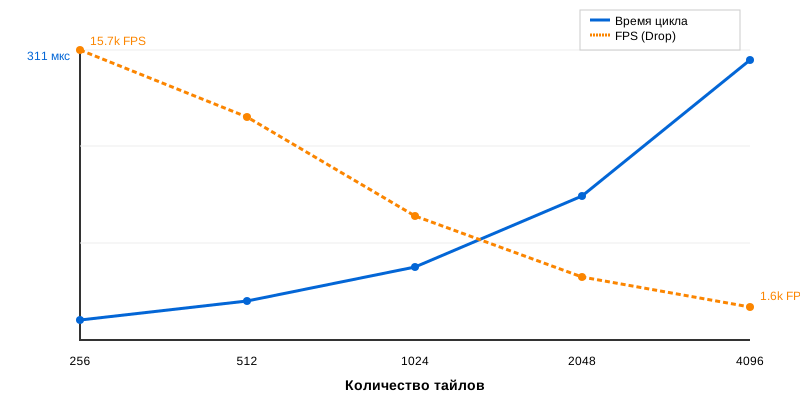
Performance graph on i5-3550 (single core)
Scaling:
When doubling tile count, execution time approximately doubles (factor 1.88–1.98). After 1024 tiles growth accelerates — cache misses and memory pressure take effect. This is physical CPU limitation, not algorithmic.
Important: For each configuration time is constant and doesn't depend on network activity. 100% tile load doesn't increase latency.
Memory:
Emulator uses ~57 bytes per tile. For 4096 tiles requires ~228 KB — fits in L2/L3 cache of modern CPU.
Determinism
Cycle time spread is minimal (± OS jitter). This is architecture consequence:
- No dynamic allocations in runtime
- No data-dependent branching
- Fixed READ → WRITE cycle
On FPGA/ASIC time will be determined by clock frequency and pipeline depth, not network load.
Application:
| Task | Requirements | Decima-8 (4096 tiles) |
|---|---|---|
| Robotics | 1–10 ms cycle | 0.3 ms (margin 3–30×) |
| HFT (analytics) | < 1 ms | 0.3 ms |
| Audio processing (block processing) | 1-10 ms block | 0.3 ms (margin 3-30×) |
Note: Decima-8 emulator (4096 tiles, ~311 μs) is suitable for predictive analytics in trading cycle and audio-DSP with block processing (64+ samples). Tasks with sub-millisecond requirements — direct order execution (tick-to-trade < 1 μs) or sample-by-sample processing (22.7 μs @44.1 kHz) — require FPGA/ASIC or smaller fabric configuration.
🧩 Benchmarks Summary
| Metric | Value |
|---|---|
| Minimum latency | 22 μs (256 tiles) |
| Maximum size | 4096 tiles in 311 μs |
| Scaling | Linear (O(n)) |
| Jitter | Absent (determinism) |
| Memory | Compact (L3 cache) |
5. SOFTWARE ECOSYSTEM
Decima-8 is not just hardware. It's a set of tools for creating, testing, and running neuromorphic personalities.
5.1 D8P Format
Status: Open specification (MIT)
File .d8p (Decima 8 Personality) is a container for swarm "personality". Contains no code. Only data.
Structure: TLV (Type-Length-Value) with CRC32 checksum.
Why TLV:
- New block types don't break old parsers
- Easy to check file integrity
- No need to load entire file to memory for validation
libd8p — open library (C++, MIT) for working with format: parsing, validation, generation.
💭 Anyone can write their own .d8p generator: in Python (PyTorch/NumPy), Rust, C++, or even manually in hex editor.
5.2 IDE
Status: Closed binary, free to use
Characteristics:
- Static build, no dependencies
- Windows (MSVC 2026) / Linux (Clang latest)
- Works offline, no internet required
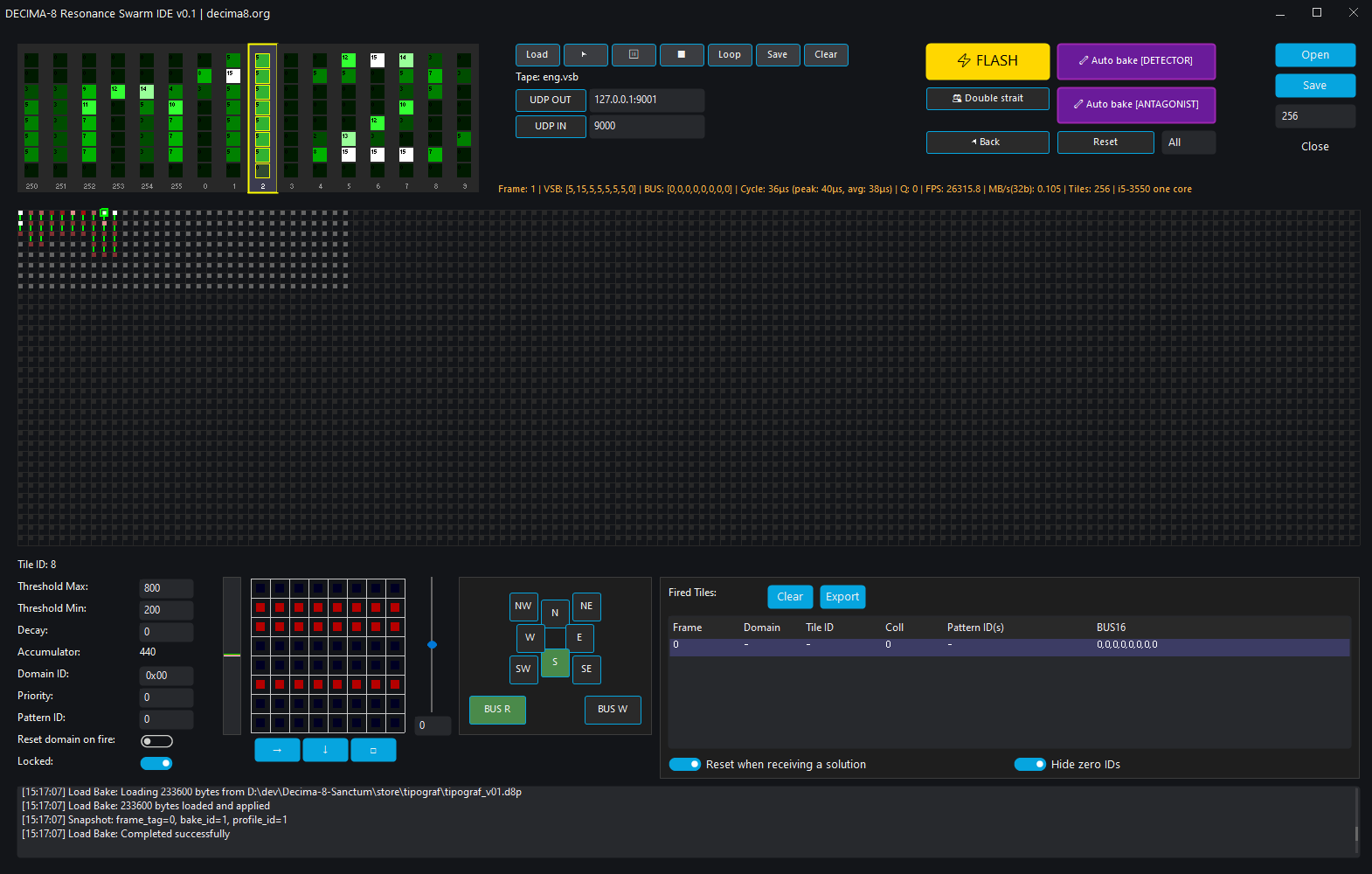
Decima-8 IDE overview
Main components:
| Component | Description |
|---|---|
| Swarm panel | Visual representation of personality fabric (activation heatmap) |
| Tile parameters | Weights, thr_lo/hi, decay, routing |
| 16-chord accordion | VSB visualizer (8 lanes × 16 chord history) |
| Tape recorder and network | Load/save VBS tapes, receive/send VSB via UDP |
| Control panel | Flash: run machine clock, Reset: reset domains, Autobake |
| Decision output panel | Shows PATTERN_ID, BUS16, FLAGS |
Visual baking: mouse-adjust thresholds, weights and connections, observing swarm response in real time.
5.3 Core Emulator
Status: OPEN SOURCE (MIT)
Emulator is "source of truth" for math verification.
Purpose:
- Personality testing before FPGA/ASIC load
- Integration in CI/CD, auto-tests
- Studying architecture "from inside"
Functionality:
- Bit-accurate compatibility with hardware (emulator → FPGA → ASIC)
- API:
EV_FLASH,EV_BAKE,EV_RESET_DOMAIN - Read FLAGS, BUS16, statistics
- C-API for Python/Rust/C++ integration
Usage example (Python):
import d8p

swarm = d8p.load("personality.d8p")

for i in range(1000):
    swarm.ev_flash(vsb_ingress=[7,12,3,10,4,14,0,9])
    readout = swarm.read_bus()
    print(f"Tick {i}: BUS16 = {readout}")
5.4 Store (Personality Marketplace)
Status: Curated platform
Store is a place for publishing and sharing ready personalities.
Workflow:
- Generate .d8p — by any means (IDE, script, neural network)
- Sign with PKI key — authorship and integrity guarantee
- Publish in Store — specification validation + signature check
- Community use — download, integration, reviews, monetization
Publication requirements:
- Valid .d8p (specification compliance)
- PKI signature (obtained via Tile/Cluster/Council subscription)
- Minimal frontend (Conductor code for running)
- Documentation (inputs/outputs description)
💭 Store doesn't check Conductor code (author's responsibility), but checks
.d8pfor spec compliance and signature validity.
Why PKI signature?
This is not paywall, but trust chain:
- Guarantee that personality created by verified author
- Protection from file substitution
- Reputation system (reviews, author ratings)
Already published personalities are not deleted on subscription expiration.
🧩 Ecosystem Summary
| Component | Status | Purpose |
|---|---|---|
| Format .d8p | ✅ OPEN | Personality container |
| libd8p | ✅ OPEN | Parsing, validation, generation |
| Emulator | ✅ OPEN | Testing, verification |
| IDE | 🔒 CLOSED (Free) | Visual tuning |
| Store | 🔒 CLOSED (Curated) | Publishing and sharing |
Open core, closed cockpit. You can create .d8p any way, but PKI signature needed for Store publication.
6. SECURITY
Decima-8 doesn't make system "invulnerable". It makes risks predictable and localized.
Architectural risk model
| Component | Risk | Protection |
|---|---|---|
| .d8p | ❌ None | Data (TLV), no code, no pointers |
| Emulator (core) | ❌ None | Determinism, bounded arithmetic, saturate |
| Personality frontend | ⚠️ Yes | Sandbox, limits, author reputation |
| Conductor (your code) | ⚠️ Yes | Classic security practices |
.d8p is data, not program. Contains no executable code, no eval, no recursion. File cannot execute RCE, overflow stack, or allocate memory.
Emulator is deterministic machine. Fixed clocks, Level16, clamp-arithmetic. "Bad" data doesn't exist — only values 0..15. Overflow impossible by design.
Frontend and Conductor — your responsibility. Code that transforms external data to Level16 and reads BUS16, works with network, FS, JSON. Classic vulnerabilities apply here (parsing, buffers, network).
Principle: Core is clean. Perimeter is yours.
Topology validation
Besides CRC32 and PKI signature, emulator performs static graph analysis before load:
- Check for positive feedback loops
- Limit on maximum tile connectivity degree
- Limit on total gain coefficient in component
If graph fails validation — load rejected with TopologyValidationError.
This is not "antivirus". This is personality physical sanity check.
Store: publication requirements
When publishing personality to Store, author provides:
| Component | Status | Check |
|---|---|---|
| .d8p file | Required | Spec validation + PKI signature |
| Frontend (minimal) | Required | Not checked (user code) |
| Documentation | Required | 8 strings description, outputs interpretation |
| Run example | Required | Script / instruction |
Why we don't check frontend:
- Technically impossible (code in Python/Rust/Go/C++)
- Legally complex (don't want to bear responsibility)
- Philosophically wrong (Decima-8 is open standard)
Instead of check:
- Publication requirement (no frontend = no publication)
- User warning ("run in sandbox")
- Rating system (reviews, author reputation)
Recommendations
When loading personality from Store:
- Run in sandbox (Docker, VM, seccomp, AppArmor)
- Limit network access (if not required)
- Set memory and CPU limits (cgroups, ulimit)
- Check author reputation (rating, reviews)
When publishing:
- Provide minimal working frontend
- Document inputs/outputs (8 strings, BUS16, PATTERN_ID)
- Warn about risks (network, FS, external APIs)
What we DON'T guarantee
| Don't guarantee | Why |
|---|---|
| Bug-free frontend | Author code, you responsible |
| Conductor stability | Your code, you responsible |
| .d8p describes "good" personality | Check physics, not semantics |
| PKI key not compromised | Store keys securely |
Summary: Decima-8 localizes vulnerabilities. Attacking core impossible (no code, determinism). Attacking perimeter possible — but these are classic vectors with classic defenses.
💭 Architectural honesty: you know exactly where risk is and where not.
7. DISTRIBUTION MODEL
Decima-8 develops as open specification project with curated personality marketplace. Below is how distribution and support work.
7.1 Open and closed components
| Component | Status | Purpose |
|---|---|---|
| Specs + Emulator | ✅ OPEN | Verification, integrations, forks |
| Format .d8p | ✅ OPEN | Personality container (TLV) |
| libd8p (parser) | ✅ OPEN | Validation, generation, signature |
| IDE | 🔒 CLOSED (Free) | Reference tool for tuning |
| Store | 🔒 CLOSED (Curated) | Personality publishing and sharing |
💭 Principle: specification is open — anyone can write their own .d8p generator, emulator or tool. Store — curated venue with signature validation and spec compliance.
7.2 Store publication
Personality publication in Store requires .d8p file PKI signature.
Why:
- Authorship guarantee (key bound to account)
- File integrity (signature checked on load)
- Reputation system (reviews to author, not anonymous file)
How to get key:
- Subscription to Tile/Cluster/Council tiers (automatic issuance)
- Or your own PKI key from trusted center (Corporate CA, etc.)
Important: already published personalities are not deleted on subscription expiration. Subscription needed only for loading new or updating existing.
Alternative signature: your own PKI key
Store accepts keys from any trusted centers, not only ours.
Process:
- Get key from your CA (corporate, government, etc.)
- Sign .d8p:
openssl dgst -sha256 -sign decima_key.pem \
  -out personality.d8p.sig \
  personality.d8p
- Load to Store: system will check trust chain to Root CA
Nuances:
- For public Store easier to use our PKI (Tile/Cluster/Council) — trusted by all users by default
- Your key requires users to import your Root CA
- Corporate use: internal Store + own CA
7.3 Development roadmap
Next 6 months:
- Further software development: libd8p, core, IDE, Store launch (first people), stable Nomos
6–24 months:
- FPGA prototype (verified on hardware), Release of first useful personalities (with community support)
2–4 years:
- B2B pilots (robotics, predictive analytics), Certified partners (FPGA/ASIC)
4+ years:
- IP licensing for chip manufacturers
💭 These are guidelines. Timelines may be shorter depending on resources and the community.
🧩 Summary
| Aspect | Implementation |
|---|---|
| Specification | Open, forks allowed |
| Store | Curated, with PKI signatures |
| Monetization | PKI key subscription (Tile/Cluster/Council), ASIC royalties |
| Community | Observer/Seed/Gardener — users; Tile/Cluster/Council — authors |
| Long-term | Project designed for 10+ years, not exit in 3 years |
💭 Decima-8 is an infrastructure project. Not a software subscription, but an ecosystem.
8. ARCHITECTURE EVOLUTION
Decima-8 v0.2 is minimum viable architecture. Not dogma, but starting point that proves principles work.
What's fixed forever (principles):
| Principle | Why it's foundation |
|---|---|
| Two-phase cycle READ → WRITE | Determinism, no race conditions |
| Relay activation (graph, not packets) | 0% area for routers, zero jitter |
| LevelN (multi-bit activation) | "Intention strength" encoding in one clock |
| Signed Decay (decay to zero) | Stability, natural "forgetting" |
| Fuse-by-Range (threshold logic) | Flexible patterns, resonant paths |
What can scale (parameters):
| Parameter | v0.2 (now) | v1.0+ (future) | Why |
|---|---|---|---|
| Level | 16 (0..15) | 32 / 64 | Fine activation gradation, less quantization |
| Weight | SignedWeight5 [-7..+7] | SignedWeight7 [-31..+31] | More connection expressiveness |
| Lanes | 8 | 16 / 32 | Bandwidth, parallelism |
| Fabric | 8×32 .. 32×128 | 256×1024 / clusters | Complex hierarchical patterns |
| Domains | 16 | 32 / 64 | Fine reset and priority control |
| Cycle time | 22-311 μs (emulator) | <1 μs (ASIC) | Hard real-time for extreme tasks |
Backward compatibility:
All changes compatible at principle level: - Two-phase cycle remains - Relay activation is foundation - Fuse-by-range, decay-to-zero are foundation
Open specification allows:
- Experiment: fork emulator, change
Level16→Level32, see how swarm behavior changes - Propose extensions: if your extension proves advantage — it can enter v1.0 via Spec RFC
- Build specialized variants:
Decima-8-Lite: for IoT (fewer tiles, fewer weights, low power)Decima-8-Pro: for HFT (more lanes, less cycle, determinism priority)Decima-8-Research: for science (extended metrics, debug, logging)
💭 Philosophy: we fix principles, not parameters. Level16 and SignedWeight5 are not dogma, but starting point.
9. CONCLUSION
Decima-8 is architecture that encodes activation level (Level16) in one clock, uses relay activation instead of packet routing, and guarantees deterministic execution time.
Key properties:
- Level16: 4 bits per activation, one clock per value
- SignedWeight5: signed weights [-7..+7], hardware-level lateral inhibition
- Relay activation: dependency graph instead of routers, 0% area for routing
- Two-phase cycle: READ → WRITE, fixed latency, zero jitter
- Open specification: documentation, emulator, .d8p format — under MIT
We don't promise "AGI," and in general, we're rather lukewarm on the whole concept of stochastic "AI."
We provide a deterministic computational fabric for tasks where predictability, efficiency, and expressiveness of patterns are important.
Decima-8 is a way to build computations at energy levels, resonance, and relay activation, as well as a model for creating a sustainable open community where everyone's contribution serves the purpose of suppressing chaos and promoting determinism.
💭 If you prefer a physics-based approach rather than a marketing one, join us!
FAQ
Q: Why not float32/float16? A: Level16 (0..15) is not "imprecise float", but semantic unit: energy level. For neuromorphic patterns 16 gradations enough, and fixed range gives determinism and hardware efficiency.
Q: How to train? A: Manually via IDE: adjust thr_lo/hi, decay, routing, observing swarm response. This is not ML training (gradient descent), but personality sculpture — you set behavior through parameters. Bakery (bakery.rulerom.com) is pattern reference, not auto-trainer. Plans — API for AI agents, but final validation remains with human.
Q: Can use cycles in activation graph? A: Yes. Determinism preserved thanks to locked_before — state snapshot at READ phase start.
Q: What if two tiles in same domain fuse simultaneously? A: Winner selected by priority8, on tie — by minimum tile_id. COLLIDE flag signals collision.
Q: What is "double strait" and when to use it? A: Mode where core performs two internal clocks per one EV_FLASH for selectivity increase. Used for small Hamming distance pattern recognition (e.g., ASCII characters in VSB). In IDE enabled by "Double Strait" checkbox, in .d8p sets BAKE_FLAG_DOUBLE_STRAIT. Cost: ~40 μs instead of ~20 μs.
Q: Why open specification? A: So anyone can verify math, write their own .d8p generator or fork emulator. Decima-8 is standard, not closed product.
Q: What if I want to use .d8p locally, without Store? A: Please. Signature not required for local use. Emulator accepts any .d8p after CRC32 validation. PKI — only for Store publication.
Q: Can sign .d8p with own PKI key? A: Yes. Store accepts keys from any trusted centers (Corporate CA, government UC). For public Store easier to use our PKI (Tile/Cluster/Council) — trusted by users by default.
🔖 Links
| What | Why | Where |
|---|---|---|
| Machine Specification | Comprehensive Contract for Emulator - FPGA - ASIC Binary Compatibility | CONTRACT_v02 |
| Reference Emulator Source Code, Verilog Specifications | Integration into Specific PACs, Verification | https://github.com/rulerom/decima8 |
| IDE for Visual Baking | Manual and semi-automated baking of personality neural tissue, visual inspection, and prompt adjustment of any personality fabricated | Download IDE |
| Personality Store | Platform for publishing user personalities | https://rulerom.store (release 1.04) |
| PKI | Verification of executable files, identity signature management infrastructure | https://pki.rulerom.com/ |
| Swarm Council | Implementing such a project without a full-fledged community is impossible. | https://intent-garden.org/swarm.html |